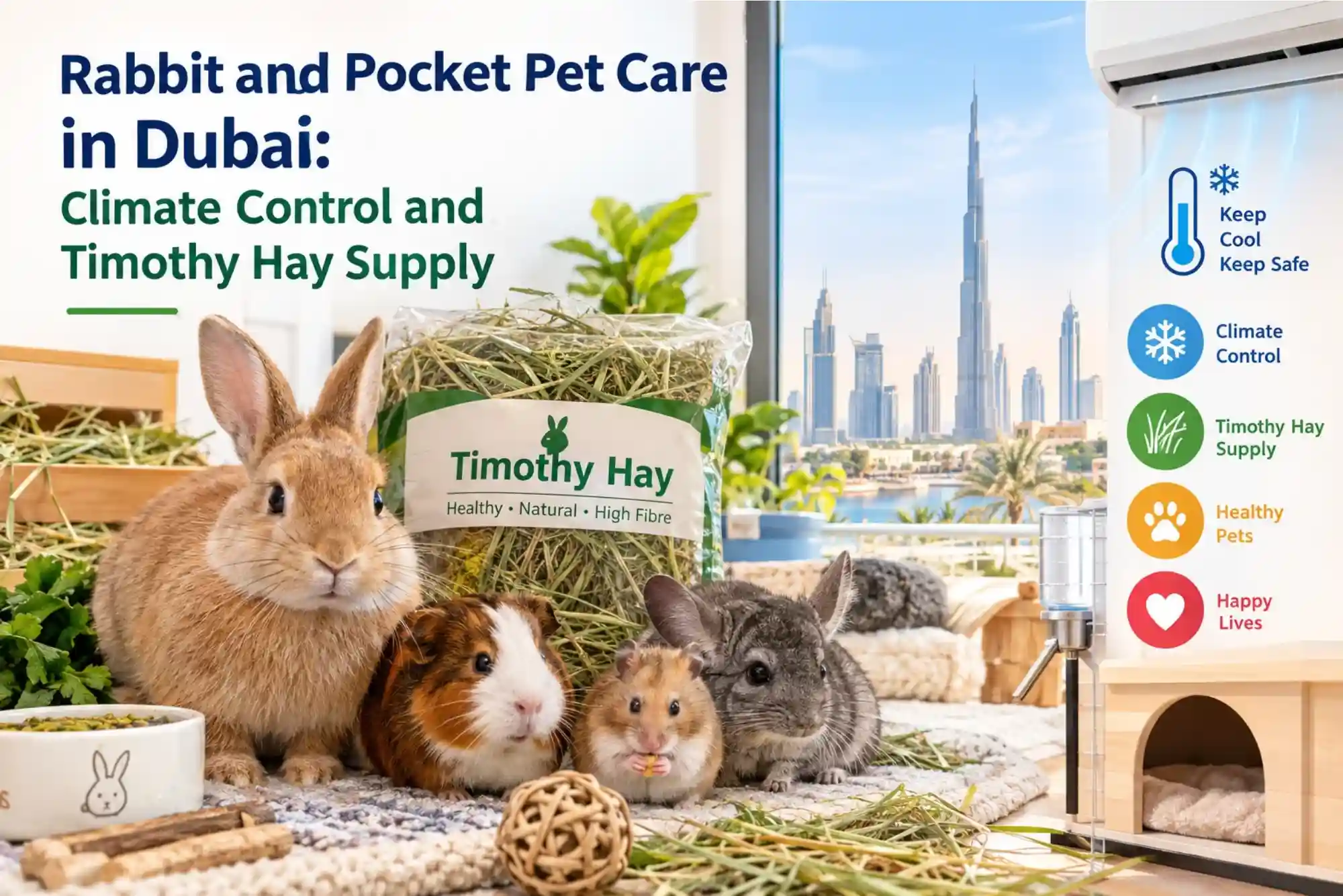
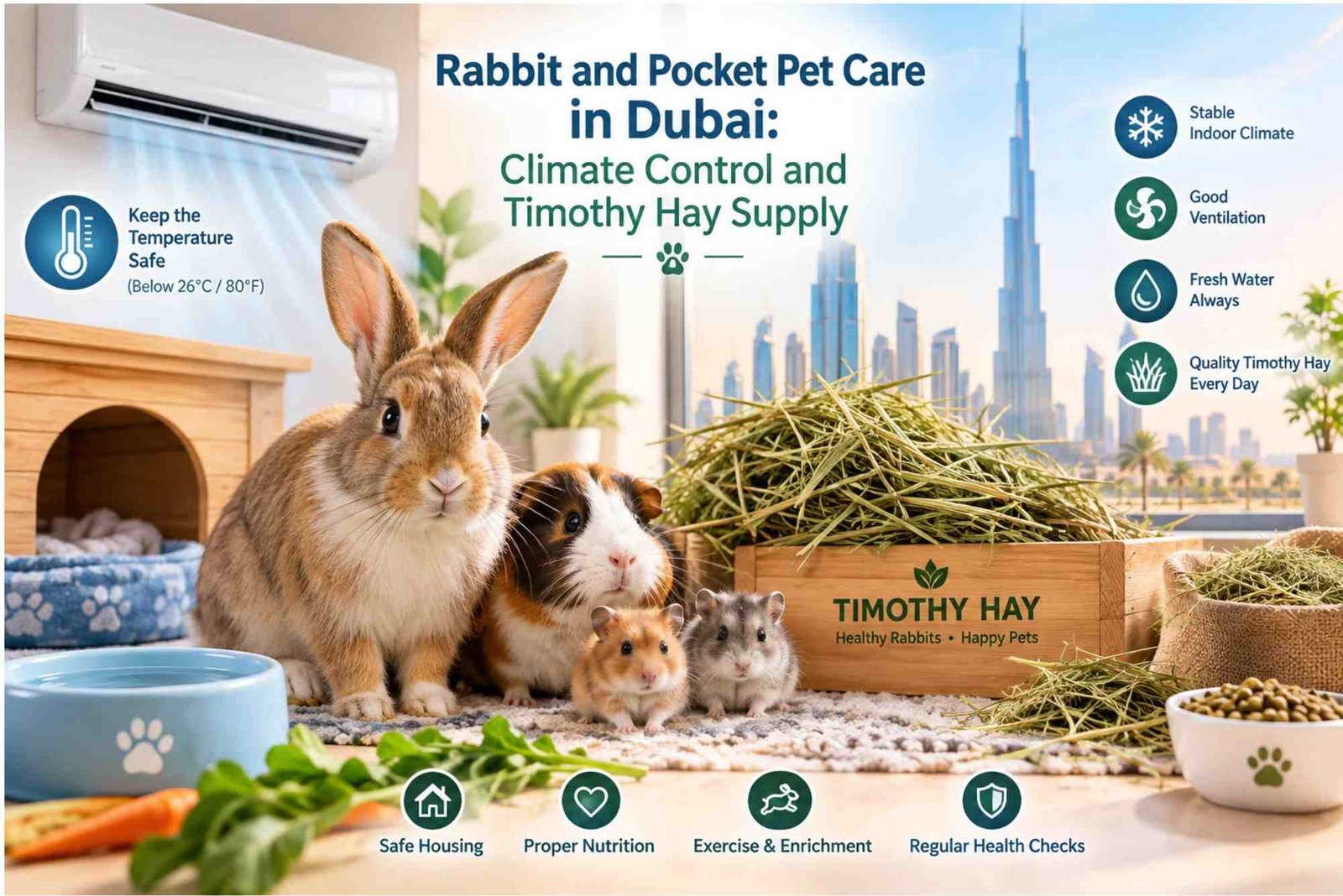
Rabbit and Pocket Pet Care in Dubai: Climate Control and Timothy Hay Supply
Keeping rabbits and other pocket pets in Dubai requires more attention to their environment than keeping small pets in a mild climate. Dubai’s hot weather means that temperature management, ventilation, hydration, housing, nutrition, and reliable access to good-quality hay all become important parts of responsible pet care.
Rabbits are particularly sensitive to high temperatures because they cannot cool themselves in the same way humans do. Veterinary guidance notes that rabbits tolerate cold better than heat and are susceptible to heat stress and heatstroke. VCA recommends keeping their environmental temperature at or below about 80°F (26°C) and ensuring good ventilation, while the Royal Veterinary College notes that rabbits are unable to sweat or pant effectively and are particularly vulnerable when temperatures rise.
For Dubai rabbit owners, this makes indoor climate control more than a matter of comfort. It can be an important part of everyday welfare. At the same time, nutrition needs careful attention. Timothy hay is a commonly recommended grass hay for adult rabbits, and high-quality grass hay should make up the majority of a rabbit’s diet. The Royal Veterinary College recommends approximately 75–80% hay or grass in the diet, while VCA describes Timothy, orchard, and brome hay as suitable grass hays that should be continuously available.
Understanding how climate and nutrition work together can help Dubai pet owners create a safer and more comfortable home for rabbits, guinea pigs, hamsters, and other small companion animals.
Why Dubai’s Climate Requires Special Rabbit Care
Dubai has a hot desert climate, and outdoor temperatures can become unsuitable for rabbits and many other small pets. Even when an outdoor enclosure is shaded, the surrounding air may remain too warm. Direct sunlight, poor ventilation, hot flooring, and enclosed spaces can make conditions even more difficult.
Rabbits are especially vulnerable because their natural cooling mechanisms are limited. Unlike humans, rabbits do not sweat over their bodies to release excess heat. Veterinary guidance therefore recommends careful temperature control and ventilation.


For this reason, indoor housing is generally easier to manage in Dubai. An air-conditioned room allows the owner to monitor the environment and maintain a more stable temperature throughout the day.
Owners should not rely only on how comfortable the room feels to a person. A rabbit may become overheated even when the owner does not feel particularly uncomfortable. A simple room thermometer can therefore be useful for monitoring the actual environment around the enclosure.
Climate control should also be consistent. Large temperature changes can create additional stress, so the objective should be a stable, comfortable indoor environment rather than repeatedly moving the rabbit between very different temperatures.
Indoor Housing Is Particularly Important for Rabbits in Dubai
Indoor housing gives owners much greater control over temperature, humidity, ventilation, cleanliness, and access to water. It can also reduce exposure to direct sunlight and other outdoor hazards.
A rabbit’s living space should provide enough room for normal movement. Rabbits should not spend their entire lives confined to a small cage. The Royal Veterinary College recommends adequate space and regular access to an exercise area, while VCA also emphasizes providing rabbits with appropriate room for movement and enrichment.
The enclosure should be placed away from direct sunlight. It should also be positioned where the air-conditioning system can maintain a comfortable room temperature without blowing strong, cold air directly onto the rabbit.
This distinction is important. The goal is not to expose a rabbit to an intense stream of cold air. Instead, the entire room should remain comfortably and consistently cooled.
If you are researching cooling equipment for a Dubai home, you can also read Classic Clap’s guide to reliable air conditioner brands and cooling considerations as a related resource.
Understanding Climate Control for Rabbits
Effective climate control involves more than simply turning on an air conditioner.
The room should have stable temperature, adequate air circulation, clean surroundings, and access to fresh water. Owners should regularly check that the air conditioner is operating properly, particularly during periods of extreme heat.
A power outage or AC failure can become a serious concern during very hot weather. Rabbit owners should therefore have a backup plan for unusually hot conditions. This could involve temporarily moving the rabbit to another safe, appropriately cooled indoor room if the primary cooling system stops working.
Fans may help circulate room air, but they should not be treated as a replacement for proper temperature control. A fan moving hot air around the room does not necessarily make the environment safe for a heat-sensitive rabbit.
Similarly, ice or frozen items should be used carefully. A rabbit should always have a comfortable place to move away from anything that becomes too cold. The main objective remains maintaining a suitable room temperature rather than attempting to cool the animal directly.
Signs That a Rabbit May Be Overheated
Rabbit owners should become familiar with changes in normal behavior. Heat stress can become an emergency, and veterinary treatment may be required.
Possible warning signs include unusual lethargy, difficulty breathing, weakness, or collapse. VCA identifies lethargy, breathing difficulty, and collapse among signs associated with heatstroke in rabbits.
A rabbit that suddenly becomes very quiet or stops behaving normally during hot weather should be taken seriously. Owners should move the rabbit to a cooler, well-ventilated environment and contact a veterinarian promptly if heat stress or heatstroke is suspected.
It is important not to delay professional veterinary care when a rabbit appears seriously unwell. Heat-related illness can progress quickly.
Why Timothy Hay Is Important
Climate control protects the rabbit from excessive environmental heat, while appropriate nutrition supports normal digestion and dental health.
Timothy hay is one of the most commonly used grass hays for adult rabbits. It provides fiber and encourages the prolonged chewing behavior that rabbits naturally need.
The Royal Veterinary College explains that hay and grass are extremely important because rabbits require constant fiber for normal digestive function, while chewing hay helps wear down continuously growing teeth.
VCA similarly identifies Timothy, orchard, and brome as suitable grass hays and recommends that high-quality grass hay form the bulk of a rabbit’s diet and remain available.
For Dubai owners, this means Timothy hay should not be treated as an occasional snack. It should be considered a basic part of the rabbit’s everyday diet.
Timothy Hay and Rabbit Dental Health
Rabbit teeth continue growing throughout life. Their natural feeding behavior involves a great deal of chewing, particularly on fibrous grasses and hay.
When a rabbit receives insufficient hay, its diet may not provide enough chewing activity. The Royal Veterinary College states that rabbits’ teeth grow continuously and that the silica in hay and grass contributes to natural tooth wear.
Dental problems can also affect eating behavior. A rabbit experiencing dental discomfort may avoid harder or more fibrous foods, creating a cycle in which reduced hay consumption contributes to further dietary problems.
For this reason, owners should pay attention to changes in hay consumption. A rabbit that suddenly stops eating hay should not simply be assumed to be picky. Dental disease or another health problem may need to be investigated by a veterinarian.
Timothy Hay and Digestive Health
Fiber is fundamental to the rabbit digestive system.
Rabbits have a specialized hindgut that depends on fermentation of plant material. The Royal Veterinary College explains that rabbits require a constant supply of fiber to keep the gut functioning normally and warns that insufficient hay or grass can contribute to serious digestive problems such as gut stasis.
This is why feeding a rabbit a diet dominated by treats, pellets, or high-energy foods is not a suitable substitute for hay.
Good-quality Timothy hay provides the roughage rabbits are adapted to consume. It also gives them something to chew throughout the day, supporting both physical and behavioral needs.
How Much Timothy Hay Should a Rabbit Eat?
For a healthy adult rabbit, hay should be available freely throughout the day.
The Royal Veterinary College recommends that approximately 75–80% of the rabbit diet should consist of good-quality hay or grass.
Rather than placing a small portion in the enclosure and waiting for it to run out, owners should ensure that fresh hay remains available. Rabbits naturally graze and may eat hay at different times throughout the day.
Hay can be offered in a suitable rack, feeder, or clean area near the litter box. Some rabbits enjoy eating while using the litter area, which can also make litter training easier.
The hay should remain clean and dry. Wet, moldy, dusty, or contaminated hay should not be offered.
Choosing Good-Quality Timothy Hay in Dubai
Finding a consistent Timothy hay supply is an important consideration for Dubai rabbit owners.
Quality matters more than simply choosing the cheapest available bag. Fresh hay should generally have a pleasant grassy smell and should not appear excessively dusty or damp.
Owners should inspect the packaging and storage conditions before buying. Hay exposed to moisture can develop mold, while poorly stored hay may become contaminated with insects or other debris.
Dubai’s warm climate also makes storage particularly important. Hay should be kept in a dry, well-ventilated location away from direct sunlight and excessive humidity.
Avoid storing a large hay supply in an area where condensation or moisture can accumulate. A cool, dry indoor storage location is generally more appropriate.
Maintaining a Reliable Timothy Hay Supply
Running out of hay should not become a regular occurrence.
A better approach is to monitor how quickly your rabbit consumes its supply and maintain an appropriate reserve. This is particularly useful for households with multiple rabbits or when hay is purchased from a supplier that may occasionally experience stock shortages.
Owners should still avoid buying more hay than they can store correctly. A huge supply kept in poor conditions can deteriorate before it is consumed.
The ideal approach is to create a simple routine. Check the remaining hay regularly, inspect its quality, and replenish the supply before it becomes critically low.
If a particular Timothy hay product is consistently well accepted by your rabbit, maintaining access to that same type can also make feeding more predictable.
What If a Rabbit Refuses Timothy Hay?
Some rabbits initially show little interest in hay, especially when they have become accustomed to highly palatable pellets or treats.
The Royal Veterinary College notes that rabbits may refuse hay for several reasons, including dental disease, excessive consumption of pellets or richer foods, and other health issues.
A gradual approach can help. Owners can offer fresh hay in different locations, try different cuts or varieties of grass hay, and make hay more interesting by placing it near areas where the rabbit naturally spends time.
However, a sudden or persistent reduction in eating should not automatically be treated as a preference issue. If the rabbit is eating less overall, producing fewer droppings, losing weight, or showing other abnormal signs, veterinary assessment is appropriate.
Timothy Hay Compared With Other Hay Types
Timothy is only one type of grass hay. Orchard and brome are other grass hays commonly used for rabbits.
Some rabbits have clear preferences. One may prefer Timothy while another may be more interested in orchard grass. Offering an appropriate variety can sometimes encourage better hay consumption.
Alfalfa is different because it is richer in protein and calcium. VCA does not recommend alfalfa as the main hay for adult rabbits, while the Royal Veterinary College notes that alfalfa may be appropriate for some young rabbits but is generally not advised as the primary hay for adults.
The appropriate diet can depend on age, health, weight, and individual circumstances, so rabbits with special nutritional needs should be managed with veterinary guidance.
Water Is Essential in Dubai’s Climate
Fresh water should always be available.
Hot weather increases the importance of hydration, particularly because rabbits can become vulnerable to dehydration when exposed to excessive heat.
Check the water supply frequently rather than assuming that a bottle or bowl will remain available all day. Water containers should be cleaned regularly and positioned where the rabbit can access them easily.
Some owners use both a water bowl and bottle, provided both are safe, stable, and kept clean. The important point is that the rabbit should have reliable access to fresh water.
During extremely hot conditions, checking water more frequently is sensible.
Fresh Greens and the Rabbit Diet
Hay should remain the foundation of the diet, but appropriate leafy greens can provide additional variety.
The Royal Veterinary College recommends greens, weeds, and herbs as part of the remainder of the rabbit diet while emphasizing the importance of hay or grass.
Diet changes should happen gradually. Sudden changes can cause digestive upset, and the RVC recommends introducing new foods slowly rather than changing several dietary components at once.
Sugary treats should remain limited. Rabbits are designed for a diet based heavily on fibrous plant material rather than high-energy human foods or sugary snacks.
Owners should also avoid assuming that every fruit or vegetable is automatically suitable. When introducing a new food, research it carefully and monitor the rabbit’s response.
Pellets Should Not Replace Hay
Commercial rabbit pellets can be useful in appropriate quantities, but they should not replace the rabbit’s primary hay intake.
The Royal Veterinary College recommends using commercial foods in limited quantities and emphasizes that hay or grass should make up the majority of the diet.
A rabbit that fills up on pellets may become less interested in hay. This can reduce the chewing and fiber intake that are important for dental and digestive health.
For adult rabbits, the exact amount of pellets should be considered in relation to body weight, activity, age, and health. A veterinarian can provide individualized guidance when needed.
Exercise and Enrichment for Indoor Rabbits
Indoor housing should not mean a sedentary lifestyle.
Rabbits need opportunities to move, explore, forage, chew, and interact with their environment. An enclosure should therefore connect to a safe exercise area or provide regular supervised opportunities for movement.
The Royal Veterinary College emphasizes that rabbits should not remain confined in a cage continuously and should have access to suitable exercise space.
Enrichment can include cardboard tunnels, safe chew items, hiding spaces, hay-based activities, and opportunities to explore a rabbit-proofed room.
Electrical cables and household plants should be protected because rabbits naturally chew and investigate objects.
Rabbit-Proofing a Dubai Home
A rabbit-proof room can be an excellent environment, but it needs preparation.
Electrical cables should be protected or kept out of reach. Small objects that could be swallowed should be removed. Toxic plants should not be accessible, and areas where a rabbit could become trapped should be blocked.
Flooring should also provide sufficient traction. Slippery surfaces can make movement uncomfortable and may contribute to injuries.
The rabbit’s litter area should be cleaned regularly, while food and water should be positioned conveniently.
VCA recommends daily spot cleaning and regular complete cleaning of litter areas.
Grooming and General Rabbit Care
Rabbit care involves more than feeding and temperature management.
Regular observation helps owners notice changes in appetite, droppings, activity, grooming, and behavior. These everyday observations can provide early clues that something is wrong.
Grooming requirements vary according to coat type. Long-haired rabbits generally require more frequent grooming to prevent mats and excessive ingestion of loose fur.
Nails should also be monitored and trimmed appropriately when necessary. Owners who are unsure how to perform grooming safely can ask a veterinarian or experienced professional for guidance.
Why Routine Matters for Pocket Pets
Rabbits and other small companion animals benefit from predictable routines.
Feeding at consistent times, cleaning regularly, checking the temperature, refreshing water, and observing behavior can make it easier to identify changes.
For Dubai households, the daily routine should include an environmental check. Before leaving a rabbit alone for an extended period, owners should make sure the AC is working, the room temperature is appropriate, water is available, and sufficient hay has been provided.
This becomes particularly important during the hottest parts of the year.
Caring for Other Pocket Pets in Dubai
The exact environmental requirements vary between species.
Guinea pigs, hamsters, gerbils, mice, and other small mammals have different nutritional and housing needs. Owners should therefore avoid applying rabbit-specific feeding rules to another species without checking appropriate veterinary guidance.
However, one principle applies broadly: small pets should have an environment that protects them from excessive heat and provides appropriate ventilation, hydration, nutrition, and enrichment.
Species-specific care is especially important when choosing food. A rabbit’s Timothy hay diet should not automatically be copied for another animal without understanding that animal’s nutritional requirements.
How Air Conditioning Can Support Pet Welfare
In Dubai, air conditioning is an important part of maintaining a suitable indoor environment for heat-sensitive pets.
The objective is consistent room cooling rather than creating extreme cold. The enclosure should not be placed directly beneath a powerful AC outlet, and sudden temperature changes should be avoided.
Routine AC maintenance can also matter. A poorly functioning cooling system may struggle during extreme weather, while dirty filters can affect airflow and indoor air quality.
For homeowners researching cooling performance and energy efficiency, Classic Clap’s article on choosing a reliable AC brand provides additional information that can complement rabbit climate planning.
A Practical Daily Rabbit Care Routine
A simple routine can make rabbit care easier.
In the morning, check the rabbit’s behavior, appetite, water, hay, and enclosure. Make sure the room remains within an appropriate temperature range and that the AC is operating normally.
Throughout the day, ensure hay remains available and monitor water. In hot weather, check the environment more frequently.
In the evening, provide appropriate greens or other diet components according to the rabbit’s established feeding plan. Clean soiled areas and allow supervised exercise or enrichment.
These routines do not replace veterinary care, but they help owners identify changes before they become more serious.
When to Contact a Veterinarian
Rabbits can hide signs of illness, so changes in normal behavior should be taken seriously.
Veterinary attention may be needed if a rabbit stops eating, produces significantly fewer droppings, becomes unusually lethargic, has breathing difficulties, collapses, or shows other concerning symptoms.
Heatstroke should be treated as an emergency. VCA specifically identifies severe lethargy, breathing difficulty, and collapse as possible signs and recommends veterinary management.
Owners should avoid attempting complicated medical treatment at home when a rabbit is seriously ill. Prompt professional assessment can be critical.
The Importance of Reliable Pet Supplies in Dubai
A reliable supply of appropriate food is one of the easiest ways to improve consistency in rabbit care.
Timothy hay should be available every day, so owners should consider availability, quality, storage, and freshness when choosing a supplier.
The same principle applies to litter, appropriate pellets, safe enrichment materials, and cleaning supplies. Maintaining an organized supply system reduces the chance of suddenly running out of an essential item.
For owners who also keep dogs or other pets, Classic Clap’s guide to heavy-duty dog harnesses and responsible equipment selection provides related pet-care information, although rabbit equipment and dog equipment should always be selected according to the individual species.
Creating a Comfortable Long-Term Environment
The best rabbit environment is one that combines suitable temperature, clean housing, good nutrition, exercise, enrichment, and regular observation.
In Dubai, climate control deserves particular attention because extreme heat can become a major welfare concern. Keeping the rabbit indoors in a stable, well-ventilated, appropriately cooled room can make environmental management much easier.
At the same time, nutrition should remain centered on high-quality hay. Timothy hay can provide the fiber and chewing opportunity that are fundamental to an adult rabbit’s everyday diet.
These two areas—environment and nutrition—work together. A rabbit living in a comfortable room still needs a proper diet, while a rabbit receiving excellent nutrition can still become seriously ill if exposed to excessive heat.
Conclusion
Rabbit and pocket pet care in Dubai requires a thoughtful approach to both climate and nutrition. The city’s hot conditions make indoor temperature management especially important for rabbits, which are highly vulnerable to heat stress. Veterinary sources recommend keeping rabbits in appropriately cool, well-ventilated environments and watching carefully for signs of overheating.
Nutrition is equally important. High-quality grass hay, including Timothy hay, should form the majority of an adult rabbit’s diet and remain available throughout the day. Hay supports normal digestive function and provides the chewing activity needed for dental health.
For Dubai owners, maintaining a dependable Timothy hay supply, storing it correctly, checking water regularly, controlling indoor temperature, providing exercise, and observing daily behavior can create a much healthier routine.
Responsible rabbit care does not depend on one product or one technique. It comes from combining a suitable environment with appropriate nutrition, enrichment, cleanliness, and veterinary support when necessary. With consistent climate control and dependable access to good-quality hay, rabbit owners can create a comfortable indoor environment suited to the demands of life in Dubai.
Frequently Asked Questions
Is Dubai too hot for rabbits?
Dubai’s outdoor temperatures can be dangerous for rabbits, particularly during extreme summer heat. Rabbits are highly sensitive to heat, so an appropriately cooled and ventilated indoor environment is generally easier to manage.
What temperature is suitable for a rabbit in Dubai?
VCA advises keeping the rabbit’s environmental temperature at or below about 80°F (26°C), while the Royal Veterinary College warns that rabbits are particularly susceptible to heat stress as temperatures rise. Individual circumstances can vary, so owners should monitor the environment and seek veterinary advice when concerned.
Can rabbits eat Timothy hay every day?
Yes. Timothy hay is a grass hay commonly recommended for adult rabbits and can be provided freely every day. High-quality hay should make up the majority of the rabbit’s diet.
How should Timothy hay be stored in Dubai?
Store hay indoors in a clean, dry, well-ventilated location away from direct sunlight and moisture. Check the hay regularly and discard any that becomes damp, moldy, or contaminated.
What should I do if my rabbit stops eating hay?
A persistent refusal to eat hay can have several causes, including dental problems or an overly rich diet. If the change is sudden or accompanied by reduced appetite, fewer droppings, lethargy, or other symptoms, contact a veterinarian.
Is air conditioning necessary for rabbits in Dubai?
Because rabbits are highly sensitive to heat, maintaining a suitably cool indoor environment can be an important part of their care in Dubai. The room should be appropriately cooled and ventilated rather than exposing the rabbit directly to a strong stream of cold air.
Can I keep my rabbit outdoors in Dubai?
Outdoor housing can expose rabbits to significant heat risk. If outdoor housing is being considered, veterinary guidance and careful environmental management are important. Indoor housing generally provides greater control over temperature and other environmental factors.
How much of a rabbit’s diet should be hay?
The Royal Veterinary College recommends that approximately 75–80% of a rabbit’s diet should consist of good-quality hay or grass.
Are pellets enough for rabbits?
No. Pellets should not replace the rabbit’s primary hay intake. Hay or grass should form the majority of the diet, while commercial foods should be offered in appropriate quantities according to the rabbit’s individual needs.
What are signs of heatstroke in rabbits?
Possible signs include severe lethargy, difficulty breathing, weakness, and collapse. Heatstroke is an emergency requiring prompt veterinary attention.