Meta Title: How to Deal with Feral Street Cats in Dubai: Community Care Guide
Meta Description: Learn how to deal with feral street cats in Dubai through humane community care, TNR, responsible feeding, veterinary support, safety practices, and Dubai Municipality resources.
Introduction
Dubai is home to a large population of free-roaming and community cats. These cats can often be seen around residential communities, industrial areas, parking spaces, gardens, construction sites, and other urban environments. Some are socialised enough to approach people, while others remain cautious and avoid direct human contact. For residents who encounter these animals regularly, knowing how to respond responsibly can make an important difference to both animal welfare and the surrounding community.
Feral and community cats should not automatically be treated as abandoned pets. Some have lived outdoors for generations, while others may have started life as domestic cats before becoming free-roaming animals. Their needs can therefore vary considerably. A frightened cat hiding under a vehicle requires a different response from a friendly cat that appears to have been recently abandoned.
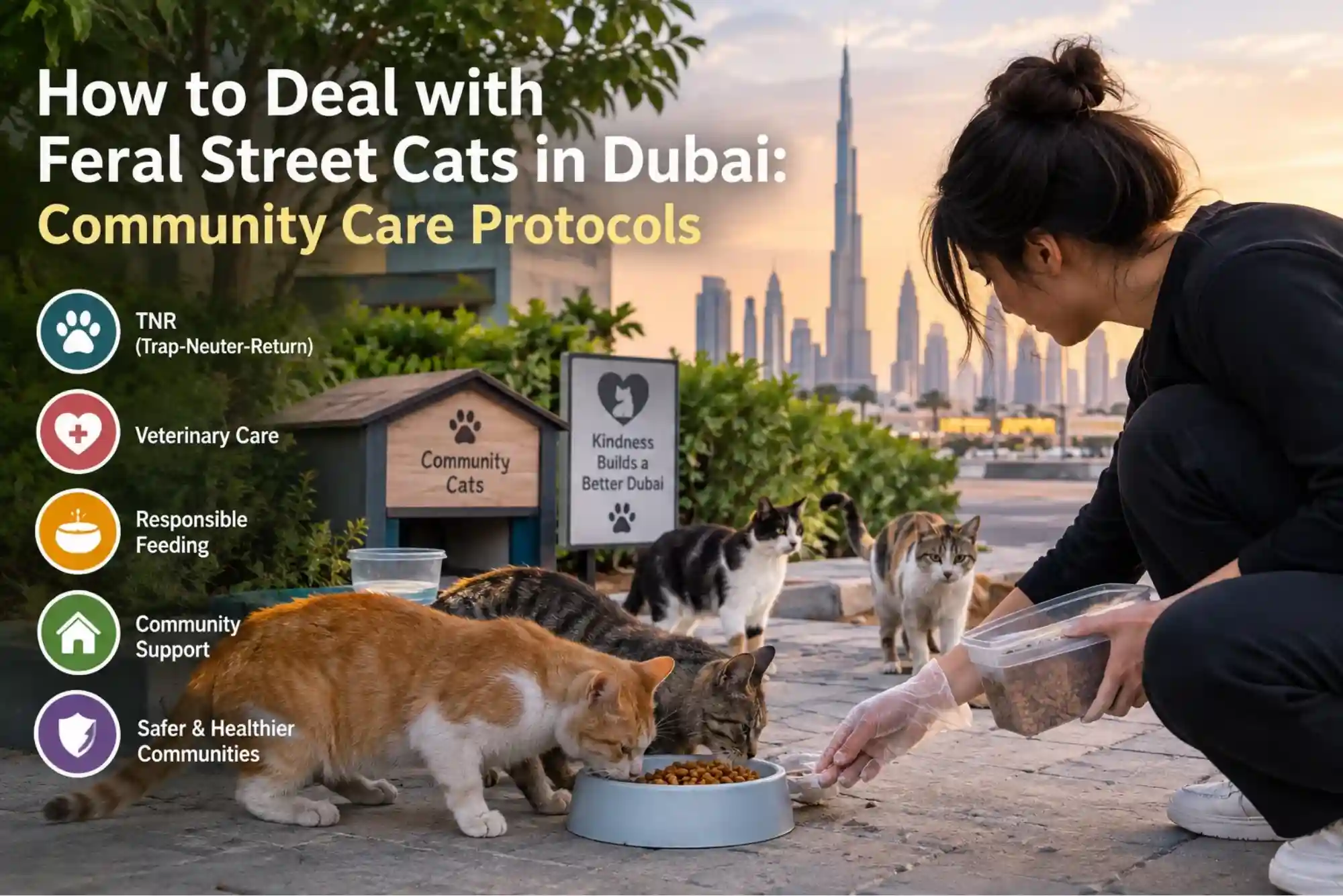
Dubai has increasingly developed a structured approach to stray and community animal management. Dubai Municipality’s current programme includes humane Trap-Neuter-Return (TNR) and, where appropriate, Trap-Neuter-Vaccinate-Return (TNVR). Under these approaches, cats may be humanely trapped, sterilised, treated or vaccinated when required, and returned to their original territory when doing so does not create a safety or welfare risk.
For residents, the most useful approach is not simply to feed cats whenever they are seen. Effective community care involves observation, responsible feeding, veterinary attention, population management, communication with neighbours, and cooperation with relevant authorities.


Understanding Feral and Community Cats in Dubai
The words “feral cat” and “stray cat” are sometimes used interchangeably, but they can describe different situations.
A feral cat generally has limited positive interaction with people and may become frightened when approached. It may hide, hiss, retreat, or avoid human contact altogether. A stray cat, on the other hand, may once have lived with people and can sometimes be comfortable around humans.
Community cats are free-roaming cats living in a particular area where people may provide some level of care. The same neighbourhood can contain a mixture of feral cats, friendly strays, abandoned pets, and owned cats that are temporarily outdoors.
This distinction matters because attempting to handle every outdoor cat in the same way can create unnecessary stress. A highly social cat may need help finding its owner or a suitable home, while a genuinely feral adult may be better suited to a carefully managed outdoor colony following appropriate veterinary intervention.
Dubai Municipality’s current animal-welfare approach recognises the importance of humane population management rather than relying exclusively on removal. Its TNR and TNVR programmes are designed to sterilise cats and, when appropriate, return them to their original locations.
Why Community Care Requires a Structured Approach
Feeding a few cats occasionally may seem like a complete solution, but community-cat management is more complicated.
An outdoor cat population can grow rapidly when animals have access to food and shelter but are not sterilised. At the same time, simply removing cats from an area does not necessarily address the underlying causes of the population problem. New unsterilised animals may eventually move into areas where food and shelter remain available.
A structured programme therefore considers the entire local situation. Residents need to understand how many cats are present, whether they are already sterilised, whether any animals appear sick or injured, where food is being provided, and whether the colony is creating conflicts with residents or property managers.
The objective should be a healthier and more stable community-cat population while protecting public spaces and respecting residents.
The Importance of TNR in Dubai
Trap-Neuter-Return is one of the most important concepts for anyone dealing with feral or community cats.
TNR involves humanely trapping a cat, arranging veterinary sterilisation, providing appropriate treatment, and returning the animal to its established territory when the circumstances are considered suitable. Dubai Municipality also uses TNVR in appropriate situations, adding vaccination to the process.
Sterilisation can reduce reproduction and can also reduce behaviours associated with mating, including some territorial conflicts and vocalisation. Over time, consistent sterilisation can help stabilise a colony.
An important part of responsible TNR is continuity. If only some cats in a colony are sterilised, unsterilised cats can continue reproducing. Community programmes therefore benefit from keeping records and identifying which cats have already received treatment.
Residents should also avoid assuming that an ear-tipped or otherwise visibly marked cat is abandoned. Such markings can indicate that the animal has already passed through a sterilisation programme.
What to Do When You First Find a Street Cat
When you notice an unfamiliar cat in your neighbourhood, begin with observation rather than immediate intervention.
Look at the cat from a safe distance. Notice whether it appears healthy, whether it is limping, whether it has visible injuries, whether it seems extremely thin, and whether it behaves like a socialised pet or a frightened outdoor cat.
Do not chase the animal simply because it is difficult to approach. A frightened cat may run into a road, hide inside machinery, or place itself in a more dangerous situation.
If the cat appears healthy and established in the area, you may not need to physically handle it at all. Instead, identify whether it is already part of a managed community-cat programme.
If the animal appears injured, seriously ill, trapped, or otherwise at immediate risk, professional assistance should be considered rather than attempting potentially unsafe handling yourself.
Dubai Municipality provides services for stray-animal management, and its public information identifies the municipality as the relevant authority for managing stray animals and related welfare concerns.
Responsible Feeding Practices
Food is one of the most visible parts of community-cat care, but feeding should be organised rather than random.
Dubai Municipality launched its Ehsan Stations initiative in 2026 to support more organised feeding of stray animals. The programme introduced AI-powered feeding devices at selected locations, with the stated goal of supporting animal welfare while reducing random feeding practices that can negatively affect public spaces.
For individual caregivers, the same principle is useful: establish predictable and clean feeding practices.
Food should be provided in an appropriate location that does not block entrances, walkways, emergency access, or other shared spaces. Feeding areas should be kept clean, and uneaten food should not be allowed to remain for long periods.
Water is also important, particularly in Dubai’s hot climate. A clean water source can be valuable for outdoor cats, but containers should be monitored and maintained hygienically.
The purpose of responsible feeding is not simply to put food on the ground. It is to create a manageable system that supports the cats without creating avoidable hygiene, pest, odour, or neighbourhood problems.
Choosing a Suitable Feeding Location
Location can determine whether a community-cat programme succeeds or becomes a source of conflict.
Feeding directly beside building entrances, children’s play areas, busy pedestrian routes, parking entrances, or private property can create complaints even when residents have good intentions.
A better approach is to identify a quieter and safer location where cats can eat without interfering with normal community activities.
Property managers and residents should communicate before establishing permanent feeding points. In residential developments, community rules may also apply.
For example, some Dubai community-management guidance specifically asks residents to contact the relevant community management or Dubai Municipality when they encounter unidentified outdoor cats. This illustrates why local coordination is useful rather than creating an independent feeding arrangement without checking the rules.
Recognising When a Cat Needs Veterinary Help
Not every outdoor cat needs emergency intervention, but certain signs should not be ignored.
A cat that cannot walk normally, has an obvious injury, is struggling to breathe, appears severely weak, or is trapped somewhere dangerous may require urgent professional attention.
Other warning signs can include persistent discharge from the eyes or nose, severe skin problems, major weight loss, unusual lethargy, or difficulty eating.
Avoid trying to diagnose the condition yourself. Community caregivers can observe and report what they see, but diagnosis and treatment should be handled by qualified veterinary professionals.
Dubai Municipality’s Veterinary Services Section is responsible for animal-health and welfare services and oversees veterinary establishments and related requirements in Dubai.
Dubai Municipality’s Role in Community Cat Management
Dubai Municipality has an important role in coordinating animal welfare and stray-animal management across the emirate.
In July 2026, Dubai Municipality opened an integrated pet shelter at the Birds and Pets Market in Warsan. The facility supports stray-animal care, veterinary services, rehabilitation, adoption, and population-management programmes.
The municipality has also stated that it uses a scientific and humane approach to free-roaming companion animals, including TNR and, where appropriate, TNVR. Cats may be returned to their original locations when doing so does not present a risk to the animals or public safety.
For residents, this means community care does not have to be a completely private effort. When a situation is beyond what an individual caregiver can safely manage, contacting the appropriate municipal service can be more appropriate than attempting to solve the problem alone.
Recent Dubai Municipality information also indicates that residents can contact the municipality regarding stray or injured cats, with the Animal Control Section able to collect animals and provide appropriate care in relevant cases.
Why Removing Every Cat Is Not Always a Sustainable Solution
It may seem logical that removing all cats from an area would solve a neighbourhood’s cat problem. In practice, population management can be more complicated.
Cats are territorial animals, and outdoor environments can continue to provide food, shelter, and other resources. If sterilised cats are removed while resources remain available, other unsterilised cats may enter the area.
This is one reason TNR programmes focus on population stabilisation rather than simply removing every animal.
Community-management guidance used in Dubai also describes return-to-origin as part of a structured approach because removing territorial cats can leave opportunities for other cats to occupy the same area.
That does not mean every cat should automatically be returned outdoors. Individual assessment remains important. A cat that is adoptable, recently abandoned, seriously ill, or unsafe in its current location may require a different solution.
Working With Neighbours and Property Managers
A successful community-cat programme depends heavily on communication.
Some residents may enjoy seeing cats around their homes, while others may have concerns about noise, cleanliness, allergies, property damage, or interactions with their own pets.
Ignoring these concerns can create unnecessary conflict.
Instead, caregivers can explain what they are doing and why. If TNR is being organised, residents can be informed that sterilisation helps prevent further litters. If feeding is taking place, explaining the cleaning routine can help address concerns about food waste and hygiene.
Property managers can also help identify appropriate feeding locations and clarify community rules.
The goal is not to make everyone feel the same about outdoor cats. The goal is to create practical arrangements that protect animal welfare while respecting the people who share the same environment.
Keeping Feeding Areas Clean
Cleanliness is one of the simplest ways to improve community-cat management.
Food should not be scattered widely across public areas. Containers should be cleaned regularly, and leftover food should be removed when appropriate.
Wet food can spoil more quickly in Dubai’s warm conditions, making timing and cleanliness particularly important.
Feeding stations should also be monitored for insects, pests, waste, and other environmental problems. If a location consistently creates complaints or hygiene concerns, the feeding arrangement should be reviewed rather than allowing the problem to grow.
The wider objective is responsible animal care that fits into the urban environment.
Supporting Adoption When Appropriate
Not every community cat is a candidate for indoor adoption, particularly if an adult cat has lived independently outdoors for a long time and has little tolerance for human handling.
However, kittens and socialised cats may sometimes be suitable for fostering or adoption.
A cat that repeatedly approaches people, seeks indoor shelter, enjoys human interaction, or appears recently abandoned may need a different assessment from a highly fearful adult feral cat.
Dubai Municipality’s new Warsan shelter also supports adoption and provides information about animals available for adoption. The municipality launched a digital adoption platform alongside the shelter so prospective adopters can review information about animals before making decisions.
Responsible adoption should always consider the animal’s health, behaviour, housing needs, and the adopter’s ability to provide long-term care.
Avoiding Unsafe Attempts to Catch Feral Cats
Feral cats can react unpredictably when frightened. Trying to grab or corner one without proper preparation can result in injury to the person or significant stress to the animal.
Do not chase a cat through traffic or attempt to pull it from a dangerous hiding place unless appropriate professional assistance is available.
For TNR, humane trapping should be coordinated with experienced caregivers, veterinary professionals, or the relevant authorities. The process should minimise stress and should be designed around safe veterinary handling.
The objective is not simply to capture the animal. It is to ensure that the entire process, from trapping through veterinary care and recovery, is handled responsibly.
Community Cat Care During Dubai’s Hot Weather
Dubai’s climate makes outdoor animal care particularly challenging.
During periods of extreme heat, cats need access to shade, water, and places where they can escape direct sunlight. Caregivers should pay particular attention to vulnerable animals, including kittens, elderly cats, and animals that appear ill.
Outdoor shelters should be placed where they do not interfere with pedestrian movement or create safety problems. Materials should also be selected carefully so that shelters do not become dangerously hot.
Cars are another important concern. Cats may seek shade around parked vehicles, so drivers should remain aware of animals that may be resting underneath or near a car.
Community awareness can reduce accidental injuries while allowing cats to remain in safer areas.
Managing Cats Around Roads and Parking Areas
Traffic is one of the major risks for free-roaming cats in urban environments.
If a colony is located close to a busy road, caregivers should consider whether the cats have safer areas available nearby. Feeding should not encourage cats to gather directly beside moving traffic.
If a cat is injured on or near a roadway, residents should avoid placing themselves in danger. Contacting the appropriate authority or professional animal service can be safer than attempting a roadside rescue without proper equipment.
Urban cat management should always consider both animal welfare and human safety.
Creating a Community Cat Care Protocol
A practical protocol starts with observation.
First, identify the cats living in the area and determine whether they appear healthy, socialised, sterilised, or already under community care. Then identify the main concerns, such as uncontrolled breeding, injuries, poor feeding practices, conflicts with residents, or dangerous locations.
The next stage is coordination. Instead of multiple people independently feeding and trapping cats, a small group can communicate about responsibilities.
Veterinary needs should be documented, and sterilisation efforts should focus on unsterilised animals. Feeding should follow consistent hygiene practices.
The colony should then be monitored over time.
This approach turns random acts of kindness into a sustainable community-care system.
Record-Keeping Can Make a Big Difference
Even a simple record can improve coordination.
Caregivers can document the approximate number of cats, identifying features, photographs where appropriate, sterilisation status, medical concerns, and changes in the colony.
This helps prevent the same cat from being trapped unnecessarily and makes it easier to identify which animals still need veterinary attention.
Records can also help caregivers recognise new arrivals. A sudden increase in unfamiliar cats may indicate abandonment, movement from another colony, or a change in available food or shelter.
Good information makes community care more organised and reduces duplicated effort.
What Residents Should Avoid
Well-intentioned actions can sometimes make community-cat problems worse.
Residents should avoid leaving large quantities of food in random locations, relocating cats without understanding the consequences, abandoning unwanted pets outdoors, or attempting to treat serious medical conditions without veterinary guidance.
Cats should also not be intentionally frightened, harmed, poisoned, or otherwise mistreated because they are considered a nuisance.
If a cat is causing a genuine neighbourhood problem, the appropriate response is to identify the cause and work toward a humane solution.
Dubai Municipality’s stray-animal service specifically addresses population management, public safety, animal welfare, and the prevention of risks associated with stray animals.
How Residents Can Support Long-Term Population Control
Long-term population control requires consistency.
Sterilisation is central to reducing reproduction, but it works best when a significant proportion of the colony is included in the programme. New arrivals should also be assessed rather than ignored.
Responsible feeding can support colony stability, while adoption can provide suitable socialised cats with indoor homes.
Residents can also help by reporting abandoned animals and encouraging responsible pet ownership. Pet abandonment can contribute directly to the number of cats living outdoors, especially when previously owned animals are unable to survive independently.
The solution therefore extends beyond caring for existing street cats. Preventing abandonment is equally important.
Community Cooperation and the One Health Approach
Animal welfare is connected to human health and the wider environment.
Dubai Municipality has described its animal shelter and veterinary approach in terms of a One Health perspective, recognising connections between human, animal, and environmental health.
For community cats, this means looking beyond the individual animal.
A healthy colony, clean feeding area, appropriate veterinary care, controlled reproduction, and responsible waste management can contribute to a better outcome for both animals and residents.
Community care works best when it is treated as an ongoing local management issue rather than a one-time rescue.
Frequently Asked Questions
What should I do if I find a feral cat in Dubai?
Observe the cat from a safe distance and determine whether it appears healthy, injured, socialised, or already part of a managed colony. For injured or problematic cases, consider contacting Dubai Municipality or an appropriate veterinary service rather than attempting unsafe handling.
Is TNR used in Dubai?
Yes. Dubai Municipality currently uses Trap-Neuter-Return programmes and, where appropriate, Trap-Neuter-Vaccinate-Return programmes to manage stray and free-roaming companion animals humanely.
Should feral cats always be taken to a shelter?
No. The appropriate outcome depends on the individual cat and its circumstances. Some socialised cats may be suitable for adoption, while some established feral cats may be managed through TNR and returned to their original territory when it is safe and appropriate.
Can I feed street cats in Dubai?
Community-cat feeding should be responsible, clean, and organised, while taking local community rules and public-space considerations into account. Dubai Municipality has also introduced Ehsan Stations to encourage more organised feeding of stray animals.
What does an ear-tipped cat mean?
An ear-tipped cat may have been sterilised as part of a community-cat or TNR programme. The marking can help caregivers identify cats that have already undergone population-management procedures.
What should I do if a street cat is injured?
Avoid unsafe handling and assess the situation from a safe distance. If the animal needs professional assistance, contact Dubai Municipality’s relevant animal-control service or a qualified veterinary professional.
Can a feral cat become a house cat?
Some cats can become comfortable with people, but adult feral cats may remain fearful of indoor life. The decision should be based on the individual animal’s age, behaviour, health, and history rather than assuming every outdoor cat should be relocated indoors.